Nikkei Slides 2.3% as Alphabet Plunge Echoes Across Asia
Asian markets diverged on Friday after Google parent's worst day in two decades spooked investors, while the Bank of Japan held rates steady at 1.25%.
By Giulia Marshall ·
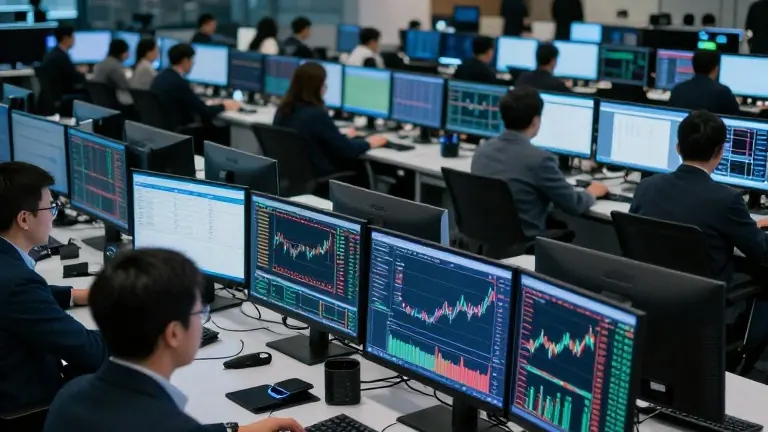
Asian equity markets opened in mixed territory on Friday, reflecting the continued market tension surrounding artificial intelligence valuations.
The Nikkei 225 in Tokyo lost 2.3% during afternoon trading to settle near 63,155.94. The decline followed a 12.6% drop in Alphabet Class A shares on U.S. markets, marking the company's steepest single-day loss since it began trading more than 20 years ago.
In South Korea, the Kospi index fell nearly 4% to 5,701.71. The drop was driven by losses in major semiconductor makers, with shares of SK Hynix and Samsung Electronics both sliding. Conversely, the Hang Seng Index in Hong Kong climbed 1.7% to 23,359.06, while the Shanghai Composite in China slipped 0.4% to 3,636.60. Australia's S&P/ASX 200 gained 0.2% to reach 8,908.10.
The Bank of Japan concluded its two-day monetary policy meeting with a decision to keep its benchmark interest rate unchanged at 1.25%. The move was widely anticipated because the central bank increased rates last month. U.S. officials have pushed Tokyo to raise borrowing costs to address the weakening yen. In currency markets, the dollar rose slightly to 157.67 yen, up from 157.65 yen, while the euro traded at $1.1186, up from $1.1181.
The volatility in AI-linked stocks has become a defining feature of recent trading. Shares in chip manufacturers and other technology firms often rise on hype but face pressure from supply chain worries. This dynamic contributed to the Nasdaq composite falling 1.4% to 26,184.72 on U.S. time. The S&P 500 dropped 0.3%, or 23.59 points, to 7,720.39, ending a four-day winning streak. The Dow Jones Industrial Average lost 132.54 points to close at 52,342.56.
In fixed income and commodities, the yield on the 10-year U.S. Treasury note fell to 4.94% from 5.05% late Wednesday. The yield has retreated from its peak of 5.30% earlier this month, which was its highest level since 2002. Energy prices held firm, with benchmark U.S. crude oil rising 1.15% to $103.17 per barrel. Brent crude, the international benchmark, increased 1.05% to $116.09 per barrel.
More Business · Customer Complaints · Report a business · Got a Story?