77.7% Turnout Leaves Israeli Election in a Precarious Deadlock
Exit polls show no clear winner, forcing weeks of negotiation between centrist rivals and Arab-led factions.
By Samir Patterson ·

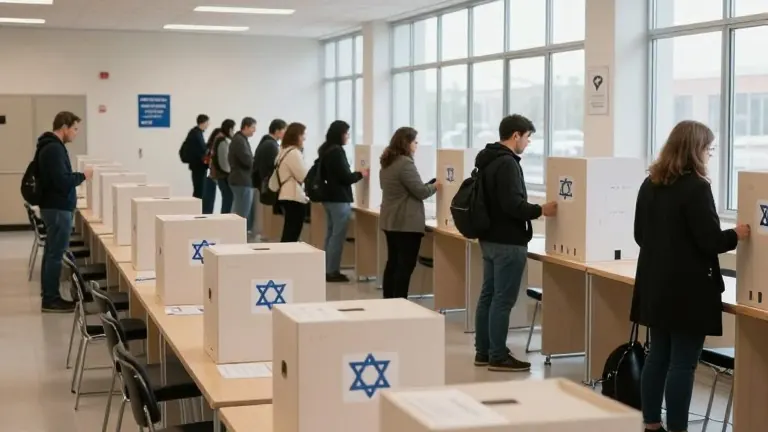
Israeli voters cast a record 77.7% of ballots on Wednesday, the highest participation rate since 1999, yet the results leave Prime Minister Benjamin Netanyahu far from defeated. Exit polls indicate that neither the incumbent far-right bloc nor the opposition has secured a decisive majority. This stalemate sets the stage for an extended period of coalition building before a new government can be formed.
With 50% of votes counted, Netanyahu’s Likud party holds 20.6% of the vote. Gadi Eisenkot’s Yashar party trails slightly at 16.8%. The Central Elections Committee has not yet determined the final seat distribution in the 120-seat Knesset. The close margin suggests that anger over the October 7, 2023 attack and the subsequent three-year war was not enough to unseat the country’s longest-serving leader.
Netanyahu declared his intent to form a strong, right-wing nationalist government. He dismissed the possibility of partnering with Arab parties, whose constituents comprise 20% of the population, calling such an alliance treasonous. Eisenkot has left the door open to including Arab parties if they recognize Israel as a Jewish state and Hamas as an extremist group. However, several likely coalition partners have previously ruled out that partnership.
The election produced a clear loser in Itamar Ben-Gvir, the far-right national security minister. Ben-Gvir’s tenure was marked by public taunting of Palestinian detainees and assertions that many in Gaza were not people. His performance reflects the unease many Israelis feel regarding Netanyahu’s alliance with the far right and draft exemptions for the ultra-Orthodox Jewish population.
Arab-led factions appear to have made a historic showing, potentially winning about 18 seats according to exit polls. Mansour Abbas, leader of the United Arab List, declared at his party headquarters that they are no longer on the sidelines. The United Arab List is the only Arab party to have joined a governing coalition, a brief occurrence in 2021. Their support may be the key to forming a parliamentary majority.
President Isaac Herzog is not required to task the party with the most seats with forming a government. The easiest path to a majority would involve Eisenkot partnering with Arab-led parties. In a speech focused on national unity, Eisenkot pledged to form a government and promised a new era of hope. His son and two nephews were killed in Gaza, a loss that his supporters believe drives his commitment to security and liberal reform.
If no coalition can secure a majority, Israel faces the prospect of another election early next year. The country held five elections between April 2019 and November 2022 due to similar political deadlocks. No single party has ever won an outright majority in parliament, meaning minority governments must rely on external cooperation to pass legislation.
Final results are expected in the coming days after hundreds of thousands of absentee ballots are counted. The outcome will determine whether Netanyahu continues his nearly 17-year rule or if a new administration attempts to restore Israel’s international standing and judicial independence.