Failed Temple Attack Sparks Surge in Anti-South Asian Hate
Police in Illinois charged a 19-year-old with terrorism after a jammed gun prevented a mass shooting at a Hindu temple, amid a 240% rise in online hate speech since 2024.
By Charlotte Dubois ·
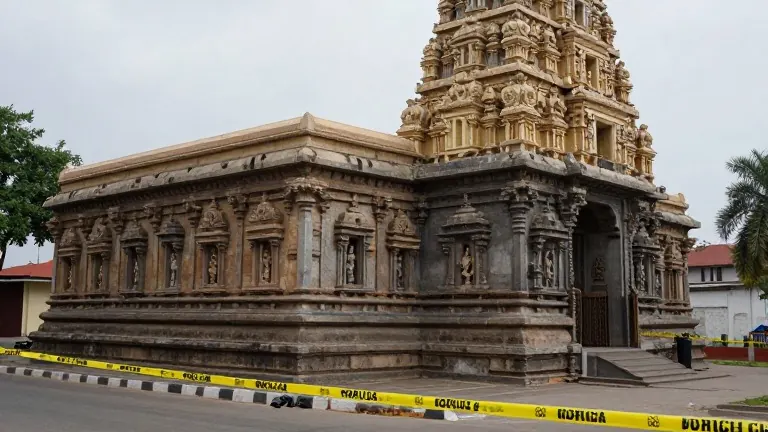
A failed mass shooting attempt at a Hindu temple in suburban Chicago is exposing a sharp increase in hostility toward South Asian Americans. Police in Palatine, Illinois, announced that Alexandros Paporakis, a 19-year-old college student, attempted to attack the Sri Venkateswara Swami Temple in Aurora on Oct. 11. Officials stated that a malfunctioning rifle prevented the attack from continuing.
Paporakis was charged with making a terrorist threat and unlawful possession of a rifle. Court filings describe an eight-page document in which he outlined his motivations. The text contained derogatory slurs directed at people of Indian ancestry, Jews, and African Americans, labeling them "subhumans." He described himself as a "sociopathic white supremacist Neo Nazi filled with hatred." Police found an AR-style rifle, 300 rounds of ammunition, eight loaded magazines, and body armor in his apartment. Items bearing Nazi symbols and anti-Indian slurs were also recovered.
The attack occurred during a major Hindu nine-day festival. U.S. Rep. Raja Krishnamoorthi attended with his family and has called for the FBI to investigate the incident as a federal hate crime. Palatine Police Chief William Nord stated at a press conference that the seriousness of the threat cannot be overstated.
Researchers link this offline violence to a recent spike in online rhetoric. Rohit Chopra, a communications professor at Santa Clara University, noted that anti-South Asian hate speech on the platform X was 240% higher between January 2025 and June 2026 compared to January 2024. Prasiddha Sudhakar, a board member of the Network Contagion Research Institute, said that fringe conspiracy theories, such as the "Brahmin Organized Government," have moved from niche forums to mainstream social media.
Sudhakar said these narratives often center on fears regarding immigration and jobs rather than demographics. She observed that hate speech spikes correlate with the political prominence of Indian Americans, such as the appointments of Parag Agarwal, Sriram Krishnan, and Usha Vance. Chopra added that the H-1B visa issue has become a political flashpoint, with Indian nationals accounting for more than 70% of those visas.
Community leaders are now urging more vocal opposition to racism. Pushpita Prasad of the Coalition of Hindus of North America noted that Hindu temples do not function as traditional congregations, making organization difficult. She said that economic success often masks the uncertainty of immigration status, with nearly half of Indian immigrants in the U.S. not yet naturalized citizens.
The incident has prompted a reassessment of the community's visibility. While Indian Americans have held high-profile positions, including U.S. Vice President Kamala Harris and FBI Director Kash Patel, Chopra argued that this does not equate to organized political power. The community continues to grapple with how to respond to a rhetoric that has shifted from the "model minority" narrative to one of dehumanization.