Experts urge Canada to prioritize legal certainty over EU associate membership label
Witnesses told parliamentarians that the lack of a formal definition for associate membership is creating confusion, while nine EU nations have yet to fully implement the current trade agreement.
By Samir Patterson ·
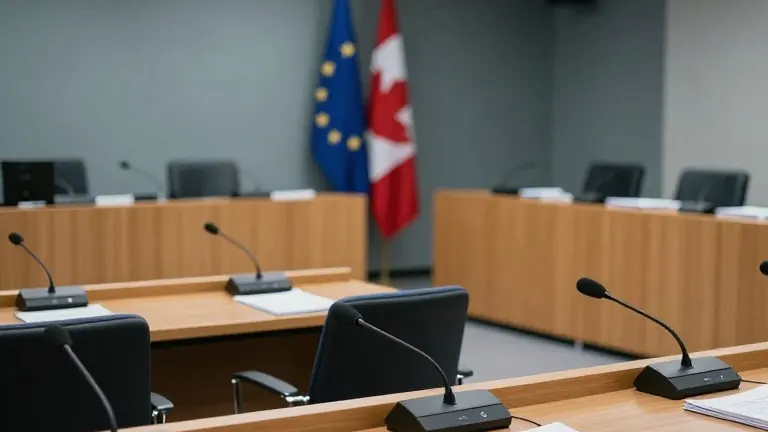
The Canada-EU summit concluded last week in Montreal with leaders praising a historic partnership, but academic experts testified on Monday that the political language may obscure the necessary legal work required to solidify the relationship.
Three main concerns emerged from the testimony before the House foreign affairs committee regarding the stability and implementation of the new bilateral arrangements.
First, the term associate member lacks an official definition. Achim Hurrelmann, co-director of the Centre for European Studies at Carleton University, described the phrasing as a distraction from policy work. He noted that the European Commission has not defined how this status would integrate into EU law. Prime Minister Mark Carney adopted the term on Thursday, aligning with language used by European Commission President Ursula von der Leyen in September, despite previously preferring the phrase alliance for the future.
Second, the current trade framework faces implementation gaps. Nine of the 27 EU member states have not yet put the Canada-European Union Comprehensive Economic and Trade Agreement into full force. Hurrelmann identified this as a mixed agreement requiring individual ratification by each nation. He suggested Ottawa restructure the deal to increase economic gains by addressing persistent friction points, such as Canadian dairy quotas and European restrictions on food imports like feta cheese.
Third, there is a risk that political momentum will not translate into durable legal frameworks. Mark Manger, a professor at the University of Toronto, testified that many current agreements are merely expressions of intent. He urged Canada to secure long-term parameters that provide clarity to firms regarding export and investment stability. Anand Sundar, a defence adviser at the European Council on Foreign Relations, added that Brussels is pushing the associate membership concept despite objections from member states like Germany.
The context for these recommendations includes rising far-right movements in Europe that are skeptical of new partnerships. Hurrelmann warned that officials may need to move quickly to establish legal force before political tides shift. He also emphasized that closer ties require cross-party collaboration in Ottawa. This challenge exists as Conservative Leader Pierre Poilievre argues the government has been unclear on its European deals and that the Montreal summit was a distraction from domestic issues.
Hurrelmann recommended that Canada focus on areas where the EU holds clear jurisdiction, such as research and academic exchanges, while negotiating directly with individual countries on defence and energy. He also proposed allowing European mobile networks to operate in Canada in exchange for dropping restrictions on Canadian food imports.
More Business · Customer Complaints · Report a business · Got a Story?